Gas masks (CBRN, nuclear, bacteriological…)
In a context of conflict or nuclear threat, an FFP2 or FFP3 rigid mask, even equipped with cartridges, remains limited: it only filters particles. A real gas mask is full-face and combines ABEK2 filters against toxic gases with P3 filtration against fine particles, biological agents and radioactive dust.
“Real” gas mask = full-face + ABEK2 filters + P3 particle filter
Full-face: a gas mask must protect the nose, mouth and eyes.
ABEK2 filters: they neutralize most toxic gases and vapors (organic, inorganic, acidic, ammonia). The indices (ABEK1, ABEK2…) indicate the capacity and duration of protection.
P3 filtration: essential to stop fine particles, biological agents and radioactive dust.
👉 It is the combination of ABEK + P3 that defines a “universal” CBRN-type filter, equipping the “real” gas masks.
What is a CBRN mask?
A CBRN mask (Chemical, Biological, Radiological, Nuclear) is a full-face mask designed to face modern threats:
Nuclear / Radiological: protection against radioactive dust and aerosols (but not against gamma radiation).
Biological: filtration of bacteria, viruses, spores and toxins carried by air.
Chemical: protection against a wide range of warfare gases and toxic industrial products.
👉 A CBRN mask must always be full-face (nose + mouth + eyes) and equipped with ABEK2 + P3 filters to cover all these risks.
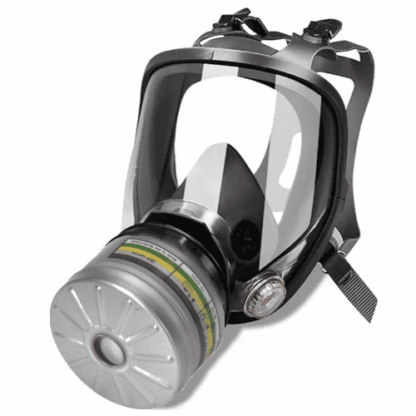
We have selected this CBRN mask and its ABEK2-P3 cartridge for its efficiency, robustness, comfort and filtering power.
Note that it also has a rare feature: it is compatible with a central cartridge (standard RD40 thread) but also with two side bayonet cartridges depending on usage. Of course, the unused connections are designed to be hermetically closed depending on whether you use one or the other filtration solution.
What does ABEK mean?
The acronym “ABEK” designates a type of protection and corresponds to the main families of pollutants:
A: organic gases and vapors (solvents, gasoline, benzene, acetone…).
B: inorganic gases (chlorine, hydrogen cyanide, hydrogen sulfide…).
E: acid gases (sulfur dioxide, hydrochloric acid, nitrogen oxides…).
K: ammonia and amine derivatives.
The number (1, 2 or 3) indicates the capacity of the filter (1 = low, 2 = medium/high, 3 = very high). Protection against CBRN risks requires ABEK2 or ABEK3.
The P3 suffix designates the most effective particle filtration (biological agents, radioactive dust, fine fumes).
The ABEK2-P3 filter (or A2B2E2K2-P3)
For scenarios with high pollutant concentration (industrial accidents, conflicts, radioactive fallout), the recommended choice is the ABEK2-P3 filter:
- High capacity against organic gases (A2), inorganic gases (B2), acids (E2) and ammonia (K2).
- P3 protection against toxic particles, viruses, bacteria, radioactive dust.
👉 This is the standard of protection used in civil security, firefighters and recommended in CBRN preparedness.
Chemical or nuclear attack: is the mask alone enough?
In the context of CBRN risks, the mask alone does not provide full protection. Since these gases can also penetrate through the skin, it is advisable to complement the protection with a full protective suit with hood and suitable gloves.
ABEK1 half-face respirators (⚠️ not CBRN)
A half-face respirator only covers the mouth and nose. It therefore does not protect the eyes and can under no circumstances be considered a CBRN mask. Even equipped with efficient filters, it remains incomplete since ocular and skin sealing is not ensured.
In addition, a half-mask cannot receive ABEK2 cartridges (high capacity, used in CBRN situations). At best, it is limited to ABEK1 filters or equivalents, designed for shorter and less critical exposures.
👉 These masks are therefore mainly suited for viral use (Covid-19, flu, epidemics), but not for CBRN threats.
The 4279+ by 3M: the only ABEK1 mask, light, discreet… but non-reusable
The highly reliable brand 3M, leader in the field of protective masks, is the only one to offer a half-mask of type ABEK1+FFP3 that is both discreet and light, notably because the filters are integrated into the mask (they cannot be detached).
The downside: you cannot replace the filters once used, making this mask a “disposable” model once the filters are saturated with particles.
FFP2 and FFP3 half-face respirators (⚠️ not CBRN)
After studying the full-face ABEK2 masks and the ABEK1 half-masks, let us now look at FFP2 and FFP3 half-face respirators, indicated for protection against viruses such as COVID-19 (for which FFP2 protection is sufficient).
Unlike the ABEK1 half-masks presented above, the cartridges of these masks are standard (these masks therefore accept cartridges from other brands), and above all the filter can be changed alone, without replacing the whole cartridge.
These masks come with FFP2 filters. If you want to filter at FFP3 level, you simply need to replace the supplied filters (only the filters, not the cartridges) with P3 filters.
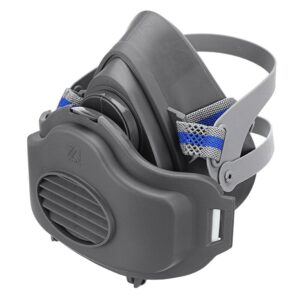
FFP2 single-cartridge half-mask
More discreet than double-cartridge masks, the FFP2 single-cartridge half-mask is a good alternative to disposable FFP2 masks for protection against viruses such as COVID-19.
Instead of side cartridges, there is a single cartridge, larger but thinner, located at the front of the mask and whose FFP2 filter (or its KN95 equivalent) can be replaced.
We offer in our shop a model of reusable single-cartridge FFP2 mask.
This product was in high demand during the most difficult periods of Covid-19. Today we have chosen to clear the remaining stock, and therefore offer it at half price. Click below to see this model.
Filter and cartridge lifespan
For bayonet cartridges containing filters, there is no need to systematically replace the entire cartridge, you can simply replace the filter inside. Although it is recommended to change the cartridge every 6 months, the filters must be changed much more frequently. It is unfortunately impossible to define precisely the lifespan of a filter as it will depend on the nature of the gases filtered and their concentration in the air.
However, as soon as breathing through the mask becomes difficult, it is time to change the filters. This means they are saturated with gases and/or particles. You therefore cannot know exactly how long the filters or cartridge will last, but you have a reliable way to identify when they become ineffective and must be replaced.
This same principle applies to know when to change an ABEK2 cartridge (as soon as breathing becomes difficult), knowing that in this specific case the entire cartridge must be changed, since ABEK2 cartridges do not have a replaceable internal filter.
The meaning of FFP2, FFP3, P2 and P3
If you are wondering why the filters mention “P2” and “P3” and not “FFP2” and “FFP3” the answer is simple: the terms FFP2 and FFP3 designate the protection level of a mask (FFP means “filtering facepiece particles”), and the terms P2 and P3 refer to a filter. A mask with P2 filters (or a P2 cartridge) is therefore an FFP2 mask, and a mask with P3 filters (or a P3 cartridge) is an FFP3 mask.
Although aware of this distinction, we use in the article the terms “FFP2 filters” or “FFP3 filters” so that you can better understand, since this term is commonly used.
