How to protect yourself from a drone attack?
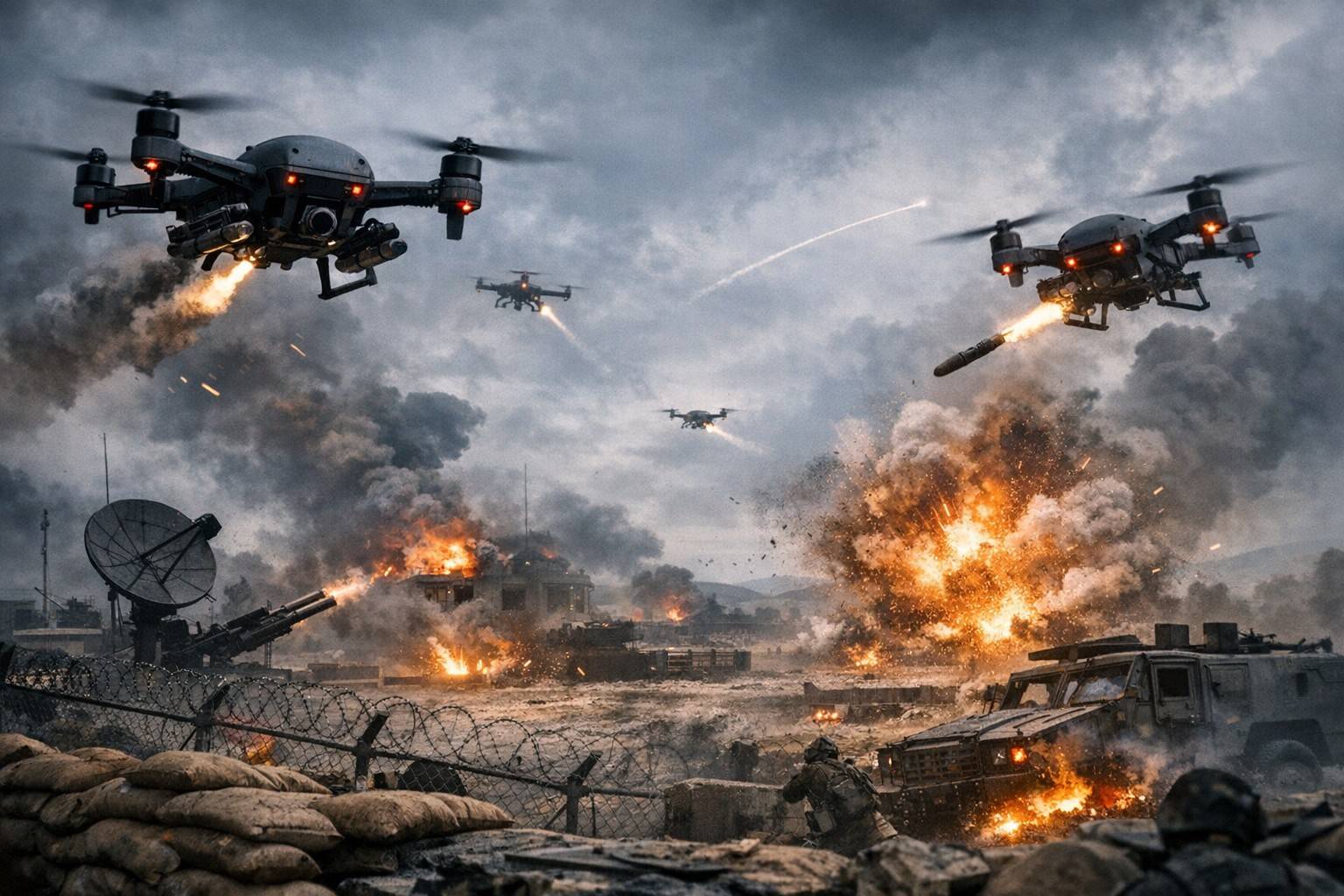
Long reserved for technological battlefields or Hollywood film sets, drones are now an integral part of our reality. Although they are mainly used for recreational or commercial purposes, international news and crime trends show a darker side: the use of drones for hostile surveillance, harassment and even direct attack.At kit-survie.org, our mission is to prepare you for tomorrow’s threats. Faced with a swarm of drones or an isolated device, panic is your worst enemy. Here’s a comprehensive guide to understanding, detecting and neutralizing (passively or actively) an unmanned aerial threat.
1. Understanding the threat: What types of drones?
Before trying to protect yourself, you need to know what you’re up against. There are generally three categories of civil and paramilitary threats:
- Surveillance drones: Discreet, they are equipped with high-definition cameras and sometimes thermal sensors. They stay at high altitude to gather information about your camp or home.
- Kamikaze” attack drones (FPV): very fast and agile, they carry an explosive charge and are piloted in total immersion by an operator.
- Drop drones: civilian models modified to carry and drop grenades or improvised explosive devices.
2. Detection: keep your eyes and ears open
Early detection is the key to survival. The sooner you spot the device, the more time you have to take cover.
Sound signals
The characteristic whistling of the propellers (often compared to a swarm of angry bees) is the first indicator. However, with wind or ambient noise, a drone can be inaudible beyond 100 meters. Learn to identify this high-frequency hum.
Visual signals
By day, look for black dots moving in a non-linear fashion. At night, most civilian drones have signal LEDs (red, green or white), although “hostile” models often obscure them with black tape.
Detection technology
For the more far-sighted, there are radio frequency (RF) detectors capable of scanning the 2.4 GHz and 5.8 GHz bands. If a strong, unusual signal is detected on these frequencies, there’s a good chance that a pilot is nearby.
3. Concealment and Camouflage Techniques
If you’re spotted, you become a target. Stealth is your first line of defense.
Thermal camouflage
Modern drones are often equipped with infrared cameras (FLIR). To evade them, it’s not enough to wear simple fatigues. Your body heat gives you away.
- Survival blankets: They block heat radiation, but beware: they tend to heat up themselves if they touch the body for too long. Ideally, you should use the blanket to create an inclined screen to dissipate the heat.
- Dense vegetation: thick foliage breaks the thermal and visual silhouette.
- Shadows: Staying in natural shadows reduces visual contrast for conventional cameras.
Breaking the silhouette
Avoid sudden movements. Rapid movement is immediately detected by the motion recognition algorithms of surveillance drones. If you hear a drone, stop, preferably against a wall or under a tree.
4. Passive Protection: Reinforcing your environment
If you’re worried about an attack on a fixed location (home, long-term self-contained base), some simple measures can save lives.
- Protective netting: Install “aviary” or construction nets over entrances and windows. They can stop an FPV drone before it reaches its target or enters a building.
- Makeshift shielding: Reinforce lightweight roofs with metal plates or sandbags to prevent puncture by dropped charges.
- Visual barriers: tarpaulins stretched over traffic areas prevent the pilot from knowing exactly where you are within your perimeter.
5. Neutralization: Can a drone be shot down?
Warning: In many countries, the neutralization of a drone is subject to strict legislation. However, in situations of survival or self-defense, here are the known options:
Electronic jamming
This is the most effective method. Jamming guns emit waves that sever the link between the drone and its pilot, forcing the aircraft to land or return to its point of departure. This is an expensive technology, often reserved for law enforcement agencies.
Physical neutralization
Shooting down a drone in mid-air is extremely difficult. Birdshot” type projectiles are the most effective for damaging propellers. For unarmed survivalists, the use of net launchers or even powerful water jets can work at very low altitudes.
6. What to do in the event of an imminent attack?
If you see a drone flying towards you, you only have a few seconds:
- Don’t run in a straight line: FPV drones are faster than you are. Look for a solid obstacle (concrete wall, large tree, vehicle).
- Lie on the ground: If the explosion is unavoidable, lie face down on the ground, hands behind your neck, mouth slightly open (to balance the pressure in your ears) and away from windows.
- Get inside: A drone is highly vulnerable when it has to operate in enclosed or crowded spaces (corridors, dense forests).
Conclusion
The threat of drones is changing the game when it comes to safety and survival. The best defense is a combination of constant vigilance, effective camouflage and intelligent planning of your environment.
Stay discreet, stay prepared.
